
 Explore Campus 360°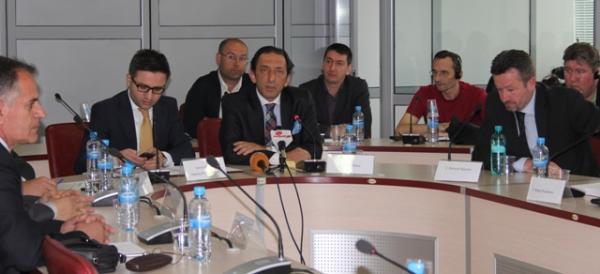
The round table on the topic “European perspectives of the Western Balkan after the Elections of the European Parliament” was organized by South East European University and the Secretariat for European Affairs.
Mr. Besimi estimated that the EU will not stop with enlargement towards the Western Balkans, with all changing trends and the changing composition of the European Parliament, after the recent EU elections.
“As for Macedonia and for the region, the European idea and Euro-Atlantic enlargement is the idea that unites. This is a process from which we would benefit”, said Besimi.
The Pro-Rector and former diplomat Prof. Dr. Blerim Reka emphasised the internal risk to Europe posed by independence movements, such as Catalonia, Scotland, the Republic of Venice, and Flemish Belgium, etc.
“They see the EU with scepticism and the extremist parties this time won more places in the European Parliament, causing a ‘political earthquake’ as the French Prime-Minister said. In the 28 EU member states, the European National Party, centre-right, remains the dominant force in Brussels, the Socialists have won a few more seats, while liberals remain the third" said Demush Bajrami, a political analyst.
“We have two opposing concepts, the Albanian entity that is for integration into the Euro-Atlantic structures, and the other concept, which is different, and is merely marking time", said Professor Fejzulla Shabani, one of the panellists in the debate.
“We have remained like a volcano crater that erupted some time ago, and we are neither in the East nor in the West, neither in the South nor in the North" said Rizvan Sulejmani, a political analyst.
The Former Deputy Prime-Minister for European Affairs, Ivica Bocevski, analyzed the representation of Euro-sceptic parties in the EP and said that “if so far we had only one voice in this direction, now this number is 120”.