
 Explore Campus 360°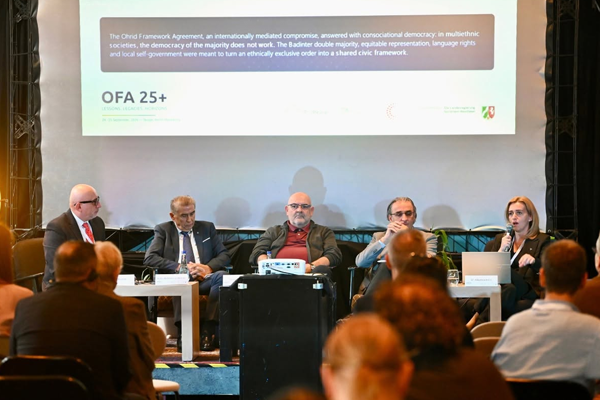
The conference provided an important space for dialogue and reflection on developments over the past 25 years. It addressed critical topics related to dealing with the past, governance, political representation, social cohesion, and the role of art and culture in post-conflict transformation processes.
On behalf of the South East European University, a welcoming address was delivered by Prof. Dr. Besa Arifi, Advisor for Community and International Relations. In her speech, she highlighted the unique symbolism of 2026, noting that SEEU marks the 25th anniversary of its establishment in the exact same year as the 25th anniversary of the signing of the Ohrid Framework Agreement.
Prof. Dr. Arifi emphasized that SEEU represents an institutional model built on respect for diversity and coexistence among communities, describing diversity as one of the key strengths and defining characteristics of the University’s culture.
SEEU representatives also made significant contributions to the panel titled “Governance, Representation, and the Political Context.” Participating as experts were Acad. Prof. Dr. Abdylmenaf Bexheti and Prof. Dr. Veli Kreci, Director of the Max van der Stoel Institute, while Dr. Albulena Halili, a Research Associate at the Max van der Stoel Institute, served as a keynote speaker.
Furthermore, SEEU students from the Skopje Campus contributed to the smooth running of the conference. Their engagement in the technical organization of this international event once again demonstrated the active involvement of students in the University’s academic and institutional activities.
Over the two-day event, participants from academia, public institutions, and civil society discussed the achievements, shortcomings, and challenges in implementing the Ohrid Framework Agreement, as well as future steps toward European integration and the development of a more cohesive, inclusive, and equitable society.